Babyloon.ai: International AI Standardisation Track from Ukraine
16 May 2026·Updated: 20 August 2026
Between 15 and 16 May 2026, two steps were taken from Ukraine on two parallel tracks of international AI standardisation. On 15 May, six technical contributions were submitted to Study Group 17 of the International Telecommunication Union (ITU-T SG17) at the United Nations — one of them devoted to the technology underpinning babyloon.ai. All six were reviewed at the SG17 meeting in Geneva in June 2026. On 16 May, an Internet-Draft was published at IETF (Internet Engineering Task Force) with the technical specification of that same element. To the author's knowledge, this is the first private initiative from Ukraine to be present simultaneously on two international AI standardisation tracks.
Two tracks — two different levels of influence
ITU-T at the UN shapes the political and regulatory framework of international standards — the reference point recognised by regulators, governments, and major players. The EU AI Act, ISO/IEC 42001, NIST AI RMF — all of these frameworks rest on the work that takes place inside ITU-T study groups.
IETF is the engineering community that shapes the technical protocols on which the internet operates. There are no government delegations here — only engineering consensus, with technical quality as the criterion. This is where Google, Cloudflare, Mozilla, Microsoft, and leading academic centres come to work.
The combination of the two tracks is rare. Teams typically work either at the political level (ITU/ISO) or at the technical one (IETF/W3C). Dual presence ensures that what gets defined at the level of policy standards has a ready technical implementation at the protocol level. And conversely — that what already works in engineering has a path into the international framework.
Six contributions to ITU-T SG17 — one of them on babyloon.ai
On 15 May 2026, an inventor from Ukraine submitted six technical contributions to the ITU-T SG17 system — as the first private initiative from Ukraine at this level of standardisation work. The proposals address an interconnected complex of tasks across two directions: digital identity of AI agents and AI security. All six were reviewed at the SG17 meeting held in Geneva in June 2026. Three of them were accepted as draft new Technical Reports — work items whose texts continue to be developed, with an editor appointed from Ukraine. Revised texts were submitted for the following SG17 meeting in Chongqing, 7–11 September 2026.
The package of six contributions rests on a patent stack developed over several years and covers a broad range of agentic-economy technologies — from AI agent identity verification to architectural accountability of their decisions. Babyloon.ai is only one of these six proposals. The other five represent further technological solutions of the same Ukrainian inventor, each claiming a place as an international standard. Every one of them will be introduced separately in upcoming publications.
To convey the substance — what follows focuses on the contribution dedicated to babyloon.ai. Its technical specification has been published in parallel at IETF.
PAIT Protocol — the technical layer of babyloon.ai at IETF
On 16 May 2026, the official IETF datatracker registered the Internet-Draft “Provenance-Attributed Inference Token (PAIT): A Protocol for Token-Level Inference Provenance and Identity-Conditioned Inference in Generative AI Systems”. The document runs to 18 pages, category Individual Submission. An IPR Disclosure (IPR 7498) was filed in parallel — the formal declaration of intellectual-property circumstances required by IETF standards.
PAIT is a wire-level specification of how an AI system can record the source of influence on each word (token) of a generated response, store this information in a cryptographically verifiable registry, and expose it through a standardised interface. The technical design is model-agnostic: PAIT requires no rewriting or retraining of models. It operates as an architectural layer that integrates directly into the inference pipeline in real time.
This principle distinguishes the approach from post-hoc audit — attempts to reconstruct provenance after the fact. PAIT makes provenance an embedded architectural attribute of the AI system, not an external check on its operation.
For regulators, this provides a real-time audit mechanism. For courts — a contestable, verifiable trail. For journalists — fact-checking at the token level. For citizens — transparency about where the AI obtained its word.
babyloon.ai — a system already in operation
The standardisation tracks rest not on theory but on a working system. babyloon.ai operates a system prototype at TRL 6 — a full architecture tested in realistic conditions. The demonstration is publicly available: babyloon-mvp.vercel.app/demo.
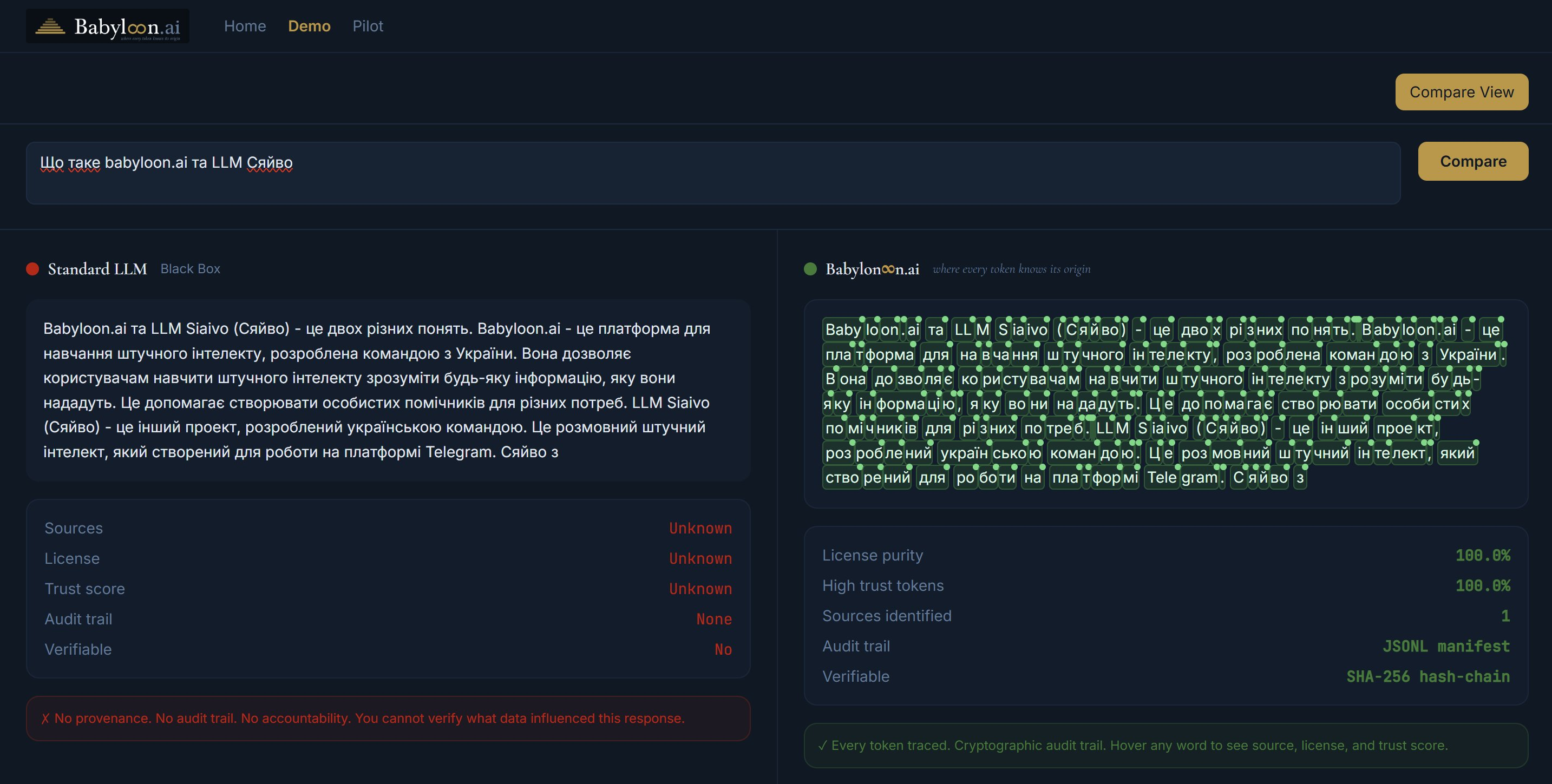
The screenshot at the top of this article shows the real operation of the system on a Ukrainian-language query. On the left: a standard LLM (Black Box) — an answer is produced, but sources are unknown, licence is unknown, audit trail is absent, verification is impossible. On the right: babyloon.ai on the same query — every token is highlighted, License purity 100%, audit trail as a JSONL manifest, verification via SHA-256 hash-chain. This is not a theoretical possibility — it is an interface that works today.
Three deployment modes, calibrated to different classes of users:
- Enterprise (approximately 99.5% attribution accuracy) — for banks, courts, healthcare, the corporate sector;
- Sovereign (approximately 99%) — fully on-premises, without cloud dependencies, for government institutions and national AI systems;
- Edge/Mobile (approximately 98%) — for environments with limited infrastructure and autonomous deployment.
Development is conducted in partnership with the University of Customs and Finance (Dnipro, Ukraine) — the academic partner of the project. UCF provides scientific expertise and the institutional context for national deployments.
Significance for the security and defence of Ukraine
Ukraine is a country defending itself against armed aggression, in a war where the informational and cyber dimensions are inseparable from the kinetic one. In this context, provenance attribution in AI, verified identity of autonomous agents, and architectural accountability of AI systems are not merely an academic topic. They are elements of cyber resilience and information sovereignty.
Counter-disinformation
AI-generated fakes are becoming an instrument of hybrid warfare. Without token-level provenance attribution, there is no way to engineer proof that generated content truly originates from the claimed source, or that it was not slipped into the training corpus. PAIT as a standardised protocol creates the infrastructural foundation for verifiable sources in wartime — for the benefit of journalists, fact-checkers, courts, and platforms.
Data sovereignty
The Sovereign deployment mode of babyloon.ai — fully on-premises, without external cloud dependencies — addresses a critical wartime requirement for the country: data in a national AI system must not depend on foreign infrastructures over which controlled access is unavailable. This is not a commercial question, but a sovereign one.
Accountability of autonomous agents
The six contributions to ITU-T SG17 close precisely the infrastructural gap that yawns today: verification of AI agent identity, delegation of authority, continuous attestation, accountability manifest. These are necessary elements for the future use of autonomous AI agents in critical infrastructure, where every action of an agent must be traceable and accountable — from energy to finance, from logistics to public services.
The European integration dimension
The EU AI Act enters full application on 2 August 2026. Articles 12 (traceability), 13 (transparency), 14 (human oversight), 50 (marking of generated content) are not procedural requirements but architectural ones. They cannot be satisfied by a filter or a policy declaration — only by a technological solution embedded in the system itself. Architectural compliance of Ukraine's national AI infrastructure from day one is a question not only regulatory but strategic.
Ukraine, the first country in the world to introduce a digital state through Diia, is now building Diia.AI, a national LLM, and an agentic state. Within this strategic window, the country has an opportunity to deploy an AI infrastructure compliant and secure by architecture — not adapted to European requirements after the fact, but designed in alignment with them from the first line of code.
An invitation to dialogue
I invite representatives of government institutions, the expert community, sectoral agencies, academic partners and the technology business community — of any state, community or organisation — to a conversation on:
- the integration of babyloon.ai into a national AI infrastructure — Diia.AI and other national digital ecosystems, national LLMs, agentic systems;
- a pilot deployment in Sovereign mode for state AI systems — a structured pilot-project proposal is available to interested institutions on request;
- joint participation in the international standardisation work — as partners, reviewers, or co-authors of future specifications.
Contact: oleg@vasylenko.tel
About the author
Oleh Vasylenko — inventor in the field of AI governance, security, and accountability of AI systems. Ph.D. in Public Administration. Director of the Ukrainian-Brazilian Centre at the University of Customs and Finance. Honorary Consul of Brazil in Dnipro. Associate Member of ITU-T SG17 (UN).
© 2026 · babyloon.ai · in partnership with the University of Customs and Finance · where every token knows its origin